
Disclosure: We build Lingoo. This comparison was written by the Lingoo team, so it is not neutral. For Duolingo, we rely on its App Store listing, Duolingo's own pages and the company's public statements. We say plainly where Duolingo is stronger and who should stick with it. As of October 2026.
For a lot of people, Duolingo is where a new language starts, and for good reason: it is free, playful and runs on every device. At some point, though, a different question comes up. The streak is long and the lessons feel easy, but could you hold a real conversation on your next trip?
If that sounds familiar, you are probably looking for a Duolingo alternative that gets you speaking. Here we compare Lingoo and Duolingo head to head, with facts, with our view, and with the points where Lingoo falls short.
The difference in two sentences
Duolingo is a playful course that every learner works through the same way, with a huge choice of languages and a strong free version. Lingoo writes each lesson for your level and your topic, and every session ends with a conversation where you do the talking.
Lingoo vs. Duolingo at a glance
| Criterion | Lingoo | Duolingo |
|---|---|---|
| Approach | Sessions of story, practice and conversation | Short lessons in a fixed course, with game elements |
| Content | Written with AI for your level and topic | Set course, the same for every learner |
| Your own topics | Pick a situation or describe your own topic | Topics are set by the course |
| Speaking | Open AI roleplay in every session, with a coach | Speaking exercises in lessons, open conversation via Video Call depending on plan |
| Getting started | Placement test, levels A0 to C2 | Start from scratch or further in if you have prior knowledge |
| Time | 5, 10 or 15 minute sessions | Short lessons, as many as you like |
| Languages for English speakers | Spanish, French, Italian, German | Many, more than 40 in total according to the App Store |
| Platforms | iPhone (iOS 26 or later) | Web, iOS, Android |
| Free | 7-day trial, no free tier | All courses free, with ads |
| Subscription | €12.99/month | Super, 14-day free trial, price shown in the app |
Duolingo details from its App Store listing and Duolingo itself, as of October 2026.
Where Duolingo is strong
- Free: Every course can be used without a subscription. That is a real advantage, and Lingoo does not offer it.
- Choice: More than 40 languages, including less common ones like Welsh, Irish and Hawaiian, plus courses in math and music.
- Motivation: Streaks, leaderboards and rewards make it easy to show up every day. For many people, that is exactly what gets them started.
- Everywhere: In the browser, on iOS and on Android.
- Video Call: With Video Call, you talk freely with the character Lily, with no penalty for mistakes. For a long time it was reserved for Duolingo Max. According to CEO Luis von Ahn, it is being rolled out to Super subscribers step by step in 2026. The app shows you whether it is available for your account and course.
Where Lingoo is better
If your goal is to speak a language, we see Lingoo ahead in three places.
1. Every session ends with a conversation
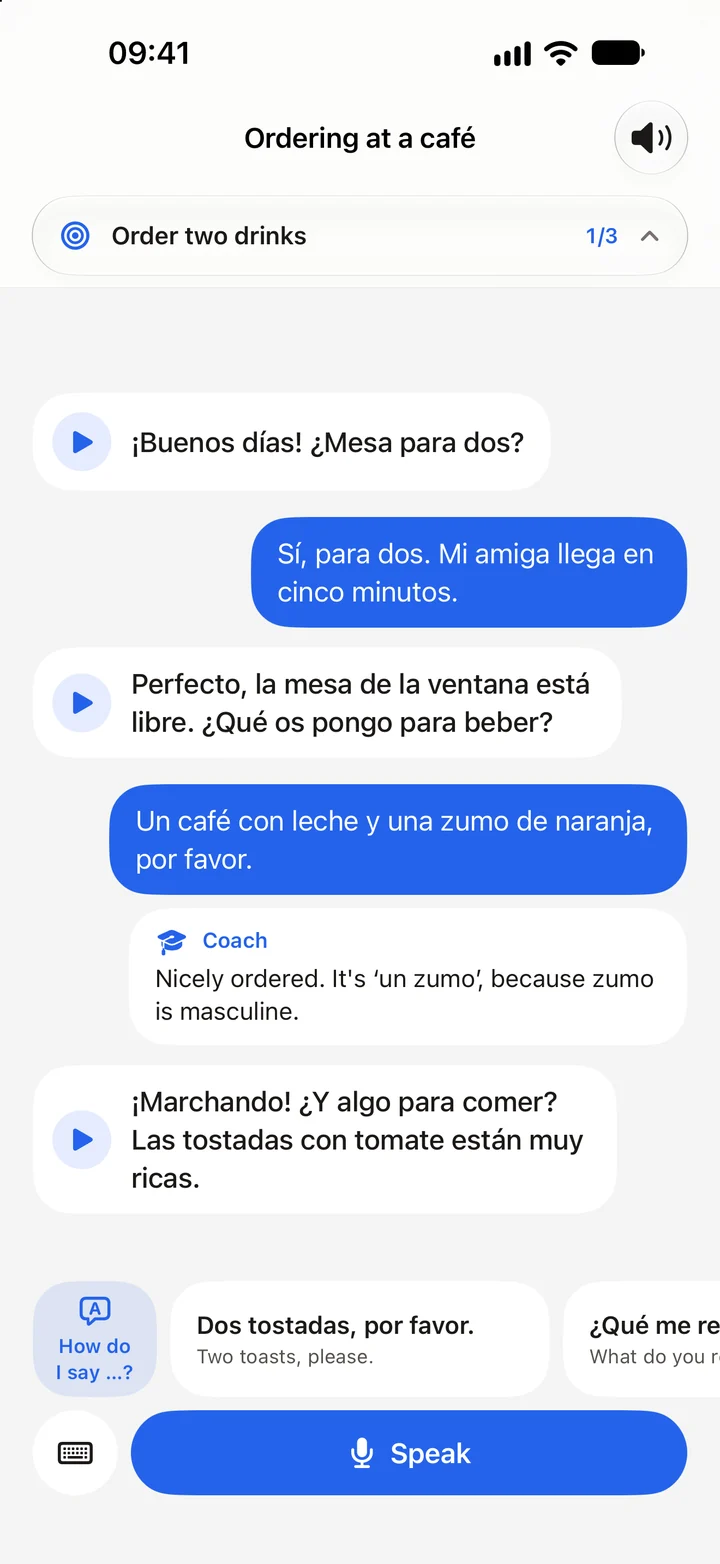
In Lingoo, speaking is not an extra; it is the third step of every session. In a roleplay you order food, ask for directions or talk about your day, using your own voice. Afterwards, a coach shows you what you could say differently. You do not need a particular plan or have to hunt for a feature. The conversation is always part of the session.
2. Your topic instead of a fixed course
Duolingo has one course that everyone works through. Lingoo writes a new story for each session, at your level and on your topic. You pick a situation such as "At the airport" or "Job interview", or just describe what you want to talk about. If you are off to Lyon next month or need to run a meeting in Spanish, that is exactly what you practice.
That has a practical upside: you learn the words you will actually need first. Someone flat-hunting in Valencia needs different vocabulary from someone heading to Madrid for a football match. And because the story is written at your level, you understand most of it while still running into enough that is new.
3. One thread through all three steps
The words from the story come back in the exercises and then in the conversation. So in a single session you meet a new word three times: read, practiced, said out loud. Later, Lingoo reviews it at growing intervals, in the sentence where you learned it.
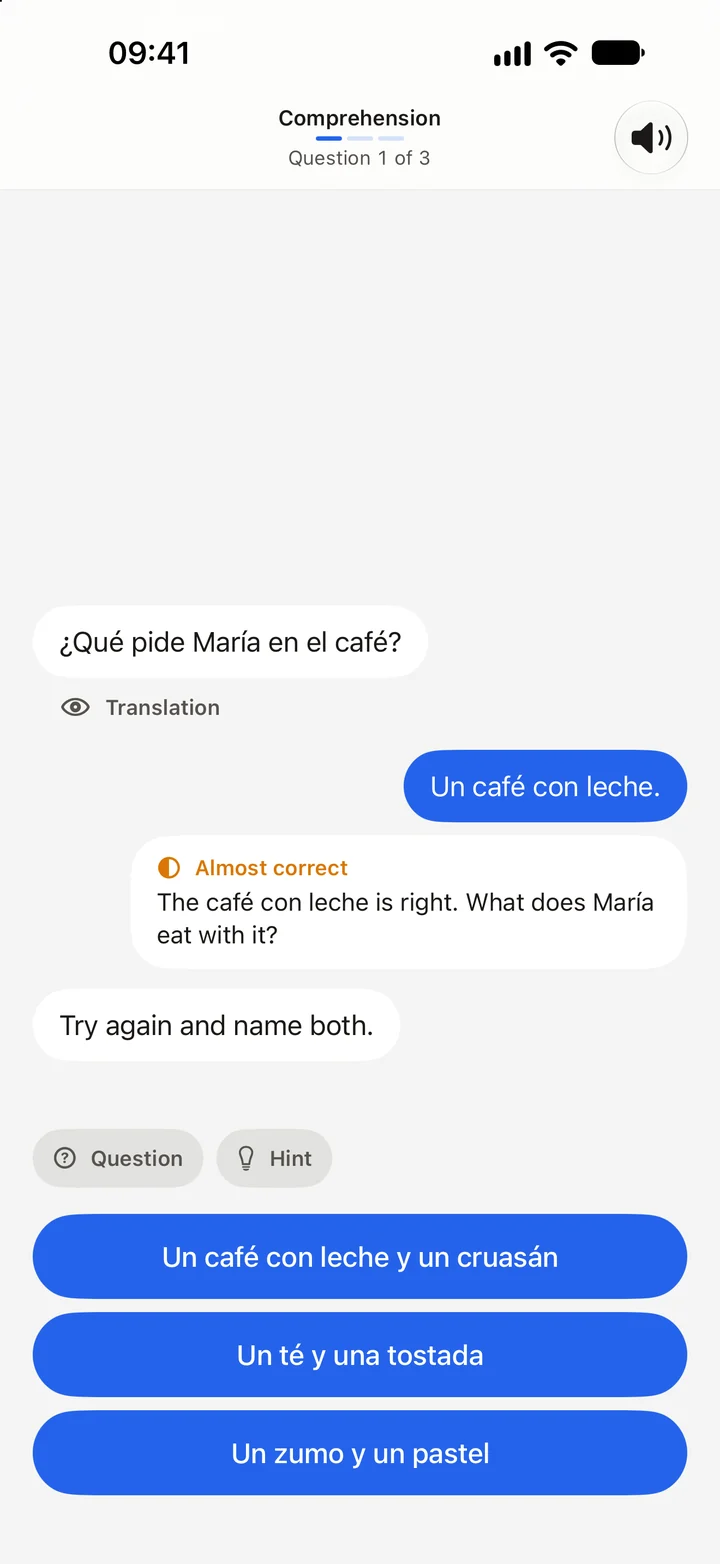
Two practical points on top: a placement test at the start finds your level between A0 and C2, and with 5, 10 or 15 minutes you know in advance how long a session will take.
Learning languages with AI: what it means in each app
Both apps use AI, but in different places. Duolingo uses it for individual features such as Video Call, while the course itself is fixed. In Lingoo, the lesson itself is created with AI: the story, the exercises and the conversation are written for you. That is why Lingoo can pick up your topics, and also why there is no fixed syllabus to tick off chapter by chapter.
We wrote in more detail about why game mechanics alone rarely lead to speaking in Why Traditional Language Apps Hit Their Limits.
Where Lingoo falls short
- No free tier: The first 7 days are free, then Lingoo costs €12.99 a month.
- iPhone only: You need iOS 26 or later. Android and the browser are not supported.
- Fewer languages: From English, you can learn Spanish, French, Italian or German. Explanations are in English or German.
- Less game: Lingoo shows your streak and your progress in words and level, but has no leaderboards or leagues.
Which one is for you
Duolingo is the better fit if you ...
- want to learn for free,
- are learning a language Lingoo does not offer,
- use Android or the browser,
- are motivated by points, leaderboards and streaks.
Lingoo is the better fit if you ...
- mainly want to speak the language,
- want to learn with topics from your own life,
- have an iPhone and are learning Spanish, French, Italian or German,
- want to put in 5 to 15 minutes a day and are happy to pay a subscription for it.
You do not have to choose just one. You can keep Duolingo for daily contact with the language and use Lingoo to train your speaking.
Bottom line
If you want to learn for free, or you are after a language other than Spanish, French, Italian or German, Duolingo is the better choice. If your goal is to hold your own in a real conversation, we think Lingoo is the stronger Duolingo alternative: every session revolves around your topic, and at the end you do the talking.
Give it a try: the first 7 days are free, and you can cancel anytime in your Apple ID settings, including during the free week. To see how Lingoo compares with Speak, Babbel, Busuu and Memrise, read The best language learning apps in 2026, compared.